Saturday, May 30, 2020

Frachtschiff Gertrude


In part five of this series we now showcase ship number three.  I wanted to have a ship unloading or offloading at the tower.  Thought it may be logical to have a supply base as everything would have had to be imported in anyway.  So the scrounging began yet again.  The hull is actually the engine nacelle from a large Mosquito kit (they come in pairs...).


Bits and pieces from an assortment of kits and dollar store toys (what did we ever do without them?).  I went with an external engine this time plus wanted some tyres on the ship.


Nice thing about the Mosquito engine casing it was already ship-shaped.  Once satisfied with the model it was off for the customary coating of red oxide...


Surprisingly, the model took more time than expected to paint and weather, even though it was just 5" long.  Besides the ship, I had to fill the cargo hold with crates, sacks and tarps.


You may notice some things changed after priming.  This happens a lot as moods and conceptualizations change during construction.


The cargo is made from various detail parts for HO-OO trains, painted and weathered.  The crew are again Graham-Farish N scale figures.  Bought all the ones with the high visibility vests I could!


On the unseen side of the ship (port side that is..) is a mounting rod; this model is meant to be attached to the structure.  Here is the "Gertrude" at the dock bringing some essential supplies to the tower.


Once the bills are paid, it's off again for another run.  Next time, the final installment of the "Tofu Tower" series.  Tales of two little boats....

Saturday, May 23, 2020

Hiya!

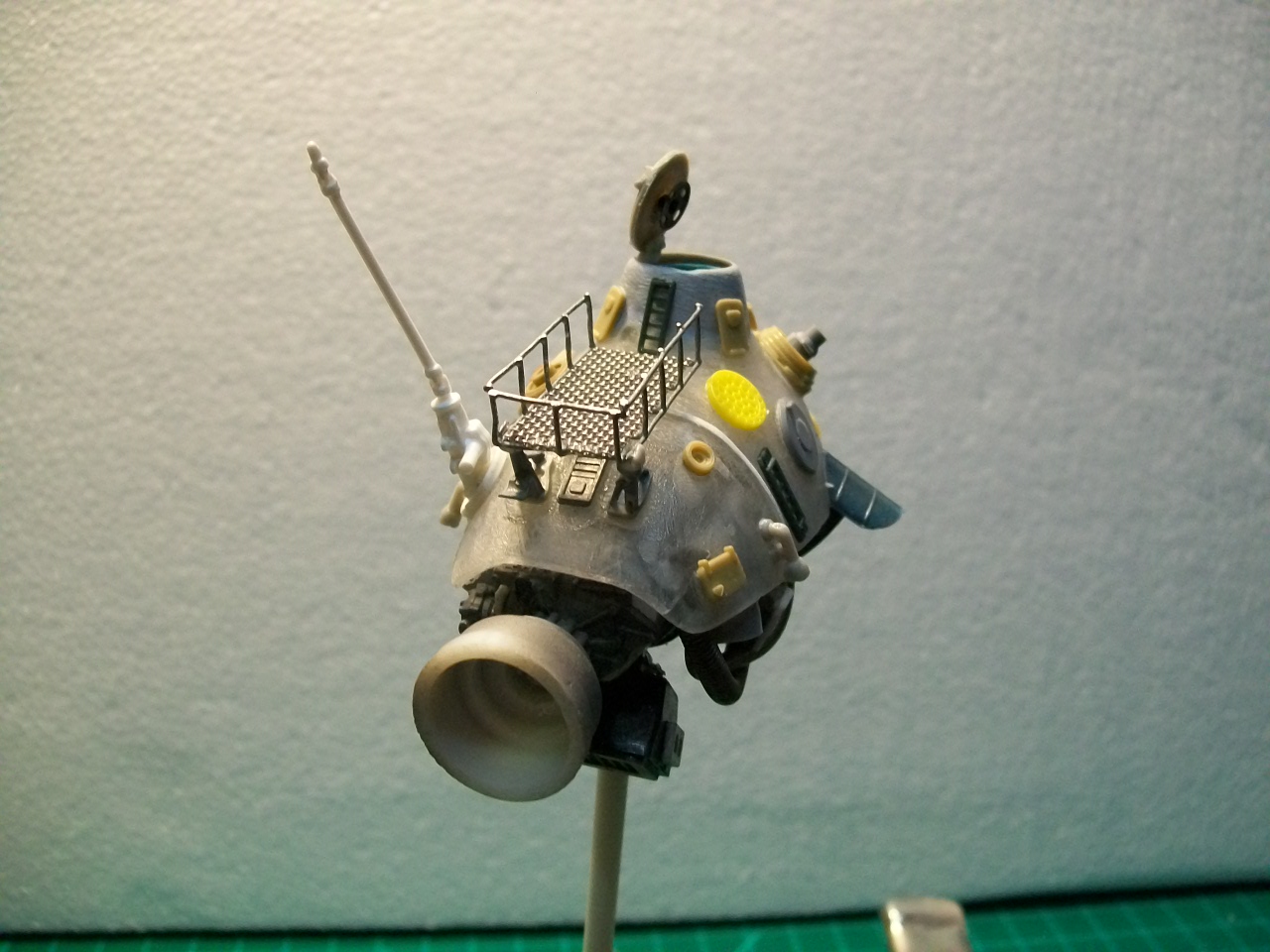
Welcome back, readers!  Tonight's second ship is the third one constructed, and compared with the rest of the "fleet", this one is unique as it's design is quite different from Mr. McQue's usual fare, but ironically it is the one closest to one of his sketches.  I think I saw it on Instagram or Twitter or somewhere, but liked the unorthodox style and configuration.  No name given to the boat, just a friendly greeting from the captain, "Hiya!"


I liked the clean lines of the hull, compared to all the mechanical "guts" dangling below.  It had the impression of being a submersible rather than an open deck ship.   Off to the parts boxes for the usual scrounging rituals!


The basic hull is just an acrylic scoop from the frequently visited dollar store,  trimmed and modified, and then a cowling from an aircraft model for the conning tower.  Because of the organic shape,  rounded greeblies  were preferred.


The ship had to have some reason or commercial intent so I added the "roof rack" of which I could place cargo, tarps, etc.  The main booster is just an inner wheel hub from a long dead truck kit.


For the guts underneath I used motor blocks, other boosters, and coil springs.  There are even some architectural model parts in there.  Once satisfied, it was Prime Time!


All other ships in this series were distressed and weathered by dry brushing, pastels and washes.  But for this I was going to use the hairspray chipping technique with multiple layers.  As the model is only 3.5" long, it was easy to apply water based paints to the hull (still haven't got that airbrush working!).   Base coat was as above, followed by hairspray, a neutral grey, hairspray, and finally a military yellow green.  After a few days to let it dry I chipped away with satisfactory results.  


After chipping, washes, dry brushing, and pastels were applied.  Metallics for the underside  and some red accents here and there.


Final details include 2 N scale "sailors", craft chain, and some cargo & tarps.  


Think out of the five ships in the fleet, this one is my favourite.  I like the smooth lines of the hull juxtaposed with the chaotic machinery underneath.  There is also a hint of "Makoto Kobayashi" as well.


For the final shot here is a view similar to the original concept sketch.  Thanks again for the inspiration, Ian!


Next time, the Tofu Tower gets a delivery!  See ya!

Saturday, May 16, 2020

Who ordered the "Big Mac"...?

Tonight's edition, (and the three yet to follow...), will concern the construction and back story of the various ships either moored or circling the Tofu Tower.  In total, six ships were built for this project, but one just didn't work out no matter how I tried to save it, so it went to another breaker's yard.


The "Malcolm-Victor", or the Big Mac as it is called by the crew, is a heavy lift ship which cruises around doing various construction and salvage jobs.  It was the second to last model in the queue, and by this time the greebly supply was getting rather sparse, so more time was spent than usual in trying to find that elusive part. 


The core of the ship is actually the housing of another dead Dremel.  Many an evening was spent searching and placing parts, then ripping them off and trying again.  Eventually the main hull was formed using the (3 part) hull of a sailboat toy from a large Kinder Surprise egg.  The cabin is an HO diesel cab, and the basic crane is from a dollar store construction toy.  Many other parts from car, plane, tank, and even architectural kits found there way onto the ship.


Once satisfied with the end product, it was off to the spray booth for some quality primer time!


This being the most complex and largest of the ships (8" in length which translates to a 100' long ship at 1/148), I knew this was going to take just as long to paint and weather it.  A Rustoleum camo green was used as the base coat, then various other paint brands with similar greens were used as accents and shade.  to finalize many shades and types of rust, siennas, reds and oranges were used for weathering.  Dry brushed, washes and pastels of course!


The crane can rotate 360 degrees, but the hook is static.  Unfortunately no lighting was included in this model.


Rather than use plastic tarps, I tried something else to give them more realism, both in colour and texture.  The tarps were made by rolling strips of latex gloves (which are everywhere these days!), and then tying them with some fine wire.  A bit of pastel was then added to give it some depth and a used look.


Hard to make out but there is cargo on the rear deck.  The Dremel shell is really not too visible except in rear shots.  Kind of a waste of a good shape now that I think of it....

The ship is named after my father, Malcolm, who passed away in 2014.  His nick name was "Big Mac", as well.  Although he was conscripted into the RAF, his dream was to serve in the Royal Navy, so I hope he appreciates this homage to his memory.  In an upcoming post, I hope to showcase his modelling skills and talents.


Unfortunately, shore leave is over, so "Big Mac" sails off into the sunset for more heavy lifting.  Next time, "Hiya"!


Saturday, May 9, 2020

The Tofu Tower

You may ask, why Tofu Tower?  For that answer we go back to 1982.  Before Ian McQue messed me up, there were many others who did one better years ago.  It was June and I had just finished viewing this little movie called "Blade Runner", and I haven't been the same since.  No need to go into the why; anyone touched by this film should understand.

So while I was starting work on the third flying ship, I realized I needed something for them to congregate around, so I imagined a little anchorage to have them either docked or flying about.  I had had the idea for this structure for quite some time; it was basically a combination of some Chris Foss paintings, primarily one called "The Face", and the Sushi Bar (tower) from "Blade Runner", which is my favorite building from the film.  (Maybe a little of the Hades flame-belching refinery too!)


Abandoning the ship, I set to work on the tower.  As you know I prefer to salvage and re purpose my modelling elements as much as possible, and use raw stock only as a last resort.  As an engineering modeler by day, I had this used model of a refinery tower with metal parts all ready and waiting!


And thus began many evenings and hours of scrounging for parts and literally anything I can get my hands on.  The omnipresent Kinder eggs, Zaini eggs, vitamin containers, bottle lids, and excess laser cutting (from work of course!).  Eventually I arrived at this core structure:


That red square on the right is actually just some support material from a 3D printer, but the weave makes it look more like a radiator.  Also pipe caps, a cab from an HO diesel, and structure parts from a big box of HO architectural shapes I got from Mister H!


Satisfied with the result from all angles, it was primer time.  I think my favourite part of modelling!


Now it was time to add details, graphics, and paint & weather the crap out of it!  Remember this is 1/148 and only 22" tall to the top of the radio mast.  From the beginning I had planned on saturating the tower with advertising, so I spent time on the internet compiling various images from (you guessed it!) that '82 film again, with a few other movie nods and related signage as well.  Before we proceed further, here is a handy guide for first time visitors to the tower:


Originally the painting started out as more vivid, but it just didn't work out.  I decided to stick to reds and rust tones with some subtle military greens and accents.  Makes the billboards stand out more.


Signage is lots of excess laser cutting, with the graphic printed on photopaper.  And then distressed and weathered of course!  The illuminated billboard was planned from the beginning.


It is a small 2" x 2" LED screen which was actually a key fob.  You can load images on it and program in a slide show.  Unfortunately the images don't show up well in photos, and you have to be almost directly in front to see them, but it is still a nice effect!  The large frame it rests in is removable for charging and reprogramming.  Too bad it doesn't have sound or moving images...


During construction of the tower, I was watching a series from the UK called "Saving Lives at Sea", a documentary about the brave volunteers from the RNLI (Royal National Lifeboat Institution).  With all the ships around I thought it would be a good idea to have one of the garage modules as a lifeboat station, and then model a small lifeboat in a rescue situation somewhere around the tower.  But we will go into this scenario on a later post...


Adding lights to the tower was a last minute decision.  I had a string of battery powered LEDs from the good ole dollar store, so I intertwined the bulbs and wires through the structure, making no effort to hide the wires.  Some of the bulbs I painted red for extra effect.  The battery box too is integrated into the model as the Generator Station:


Let's pay a visit to specific parts of the tower.  About midway up is "The Snake Pit".  A place for traditional shore leave.  The party has moved out onto the balcony!  On the roof are some tomato plants and other veg for the restaurant below, "Der Tofuhaus", and Omar's Garage is on the left.


Figures used are all N-scale from Graham Farish.  There are also some from Life-Like too.  Just below Taffey's place is the receiving dock.  Here the tower gets all the cargo and supplies it needs to operate; mostly food stuffs like other veg, rice, and tofu.  Liquor and penicillin is also shipped in for the other business above!  A cargo lighter is off loading, and we will discuss this ship again at a later date.


That cracked paint effect on the diesel tank was a bonus.  The previous yellow was too intense so I painted over it with a dirty red.  The paints were incompatible so it shrank when it dried.  I'm not complaining...  As for weathering, many hours were spent with dry brushes, washes and pastels.  I like to use an orange over the usual red oxides out there.  Look at a rusty chunk of iron; you may be surprised how many hues are present.


Moving to the top we see the taxi waiting for a fare, and another ship circling the tower.  Higher up, the lifeboat crew is answering a call.  That black square up there is the LED billboard.


At the top of the tower are the masts and radio tower.  Next to the BP sign is the vaporator.  The flexible piping is made from coil springs.


Well, it's getting that time again.  And after all this, still no answer to the topic sentence.  Why Tofu Tower...?   As it is loosely based on the Sushi Tower from that film, I altered the name according to my lifestyle.  As a long term vegan who does not eat fish, but who does eat large quantities of tofu, I thought it appropriate!


Next time, we will be visiting the individual ships; their construction and back story.

Saturday, May 2, 2020

I hate you, McQue....

Once upon a time, (modelling) life was simple.  I was content to build kits and scratch build from various Gerry Anderson series, assorted Sci-Fi television and movies, and Japanese anime mechs from the 80's & 90's.  And then it happened; I stumbled across a posting in "Concept Ships" featuring  the work of artist Ian McQue.  His colour palate and subjects of flying junk boats traversing through the air, defying gravity on some future/past Earth or other planet was inspiring!  This was 10 years ago, and from then on he has lived in my head rent free.  Since that time I have built two flying ships (see previous posts of the Cargo Barge Regina & Towboat Jean), and all the time the urge to build more as always been there.  So in the hope that if I built one more boat, I could get back to "normal" modelling.  Unfortunately, this did not work.  And the project got out of control.  What was to be one little ship mushroomed into a diorama of sorts comprising of five ships, plus a central structure to tie them all together.  The result, The Tofu Tower!


The Tofu Tower is a run down, grotty little anchorage off of the main shipping routes.  Ships and sailors who frequent this establishment want to avoid inspections and other authorities.  Here they can replenish themselves with food, water, fuel, repairs, and most important, companionship!  There is also a restaurant, a taxi service, and with all the comings and goings, an RNLI station.


For this project, I decided to change the scale so I could build bigger, but take up less space in the display cabinet.  (That is always the problem with modelling; where to put them afterwards...).  The previous ships were built at 1/35, but this time I chose 1/148, which was British N scale.  The tower is 24" high, which is almost 300 feet high in "reality".  The five ships range in size from 2" to 8".  Three are fixed/moored to the tower.


I didn't want the display to be fixed, so I came up with the idea of having movable components.  Using a steel base, I fixed magnets to the underside of the tower and aluminium plates for the two ships which allow to put them anywhere I want.  Unfortunately the acrylic rods holding up the ships are permanent, but this gives the height variation as well.  I lost track of how many months I worked on this.  It must be at least 9 months, as I only get 1 to 2 hours at most in an evening to model.  Now here are some nice close up blue sky shots!


This low angle view shows some of the many billboards, a few condenser units, and to the right, the taxi.   Here we see the most popular establishment on the tower, as well as the roof gardens.  It was all so rusty and bleak out there....


Much more of the tower, it's features, elements and construction will be discussed and described in the next post.  And the assorted ships will be done in good time as well.  But it's getting late so last call and lights out, sailors!