Tuesday, August 20, 2024

Space: 2022 - Building the PHOENIX - Part Six

Module F is the Engineering Section of the ship, and the smallest component over all.  The base unit is the Stage 3 section of the Airfix Saturn V kit, with minimal added greeblies and some other bits & pieces.  


Besides the internal brass rod, there is a salvaged lid at each end (sources long forgotten), assorted parts from small armour kits, and the "baby bottle" tanks which some of you may remember from the Hub section.  The big black disc is actually from the ends of a cardboard tube used for printing paper.  


The fastest component built as well, it was then off for priming, painting, IPA wash & weathering, and finally graphics.  Adding the last two escape pods finished off the model.  


Five technical chaps (with sleeves the same colour as that large anti-neutron shield),  work in this module.  There are two sections.  The smaller section behind the shield and about one third the size has two engineers working 4 hour rotational shifts in radiation suits.  Behind that three other engineers monitor all other ship functions, power usage, etc.  A sixth engineer is stationed in the Command Module and acts as monitor and liaison with the other members of the crew.  And of course VICTOR will be watching too!


The escape pods are shared with engineers and the technicians that may be in the Dove's Nest at the time.  Remember each one can hold five personnel.  


That about covers it for Engineering.  Sorry, not the most exciting bit, but essential none the less.  Next time will be the final component, Main Propulsion.  Have a better one!


Friday, August 9, 2024

Space: 2022 - Dramatis Personae

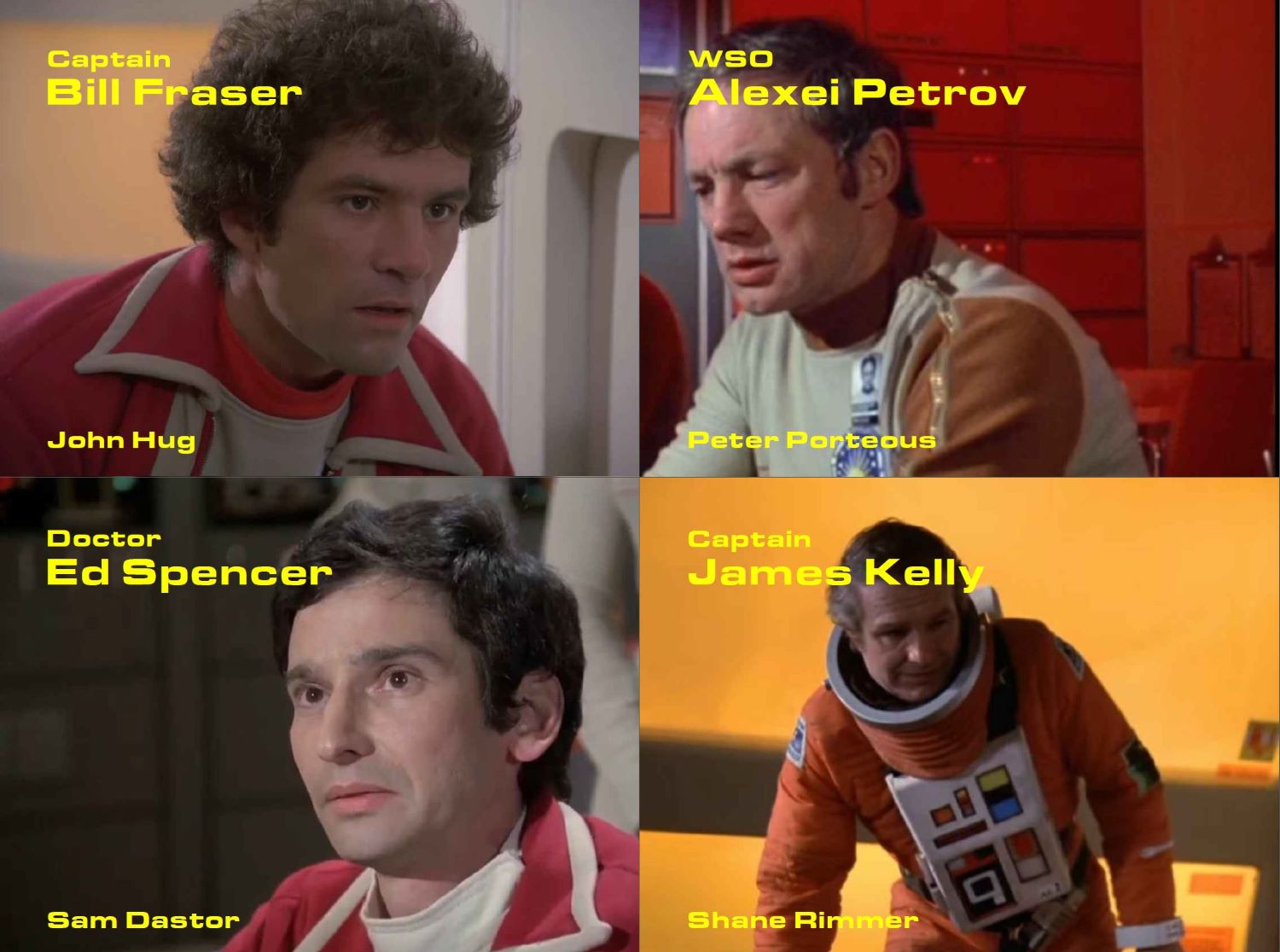
Tonight we'll take a brief intermission from the miniatures to showcase the cast & characters from "Space: 2022" - Year Two.  I've salvaged most of the original cast in one way or another (as they were transitioned in the original series), plus I've added, resurrected, and restructured the cast as I see fit, basically a Fantasy Premier League but with "Space: 1999" actors and characters.

There are 13 primary and secondary characters which will be in most episodes, among many guest stars and artists where one will be likely to say, "Oh, I saw him on that other so & so show...", or "Wasn't he in that film last week..?"  Etc., etc.  

Another thing I am injecting into the plot lines will be more conflict among the characters.  I will be avoiding all those squishy and unnecessary "Freiberger-isms" with bratty, younger characters (who were too young to be out in space anyway), and forced emotions. I have created a more mature cast dealing with an impossible and unexpected situation,  again more like Year One, but with a lot more conflict and shouting!  So, lets meet the dramatis personae!


Commissioner John Koenig (Martin Landau)

Ex-Astronaut, ex-Alpha Commander, and ex-Commissioner (Buzzard Fleet), Koenig is now employed with EUROSEC as a head hunter.  After his dismissal from the Buzzard service, (see Episodes 11 & 12 - Yr 01),  he was hired to recruit astronauts, pilots, and other scientific specialists for the new PHOENIX project.  He has assembled a crew of 109 of the finest Earth and the Moon has to offer.  As he was inspecting the ship on it's test flight to Jupiter, he is now trapped with the rest of the displaced crew.  Angry at first, he now sees an opportunity to reclaim his previous status as a Commander and restore his former glory, which will of course cause conflict with:

Commander Alan Carter (Nick Tate)

Alan was recruited to command the PHOENIX by Koenig himself.  When the military took over the radio-active waste disposal after the Icarus incident, Alan was demoted to basically a mechanic since no civilians were permitted to pilot Buzzards any longer.  Except for Koenig, he has logged the most hours of any other space pilot in Eagles, Buzzards, Doves, and other various space vehicles.  His "flying by the seat of his pants" attitude, and years of experience in space, make him perfect for command.  

CMO Doctor Helena Russell-Koenig (Barbara Bain)

After the averted disaster on the moon, Helena left Moonbase Alpha to form up the new Moonbase Gamma, a separate purpose built Lunar hospital.   This facility would research zero G medicine, effects of magnetic and other radiation, (brain damage), plus act as an isolation lab for diseases and viruses too dangerous to remain on Earth.  Chief Medical Officer Doctor Helena Russell reconnected with John Koenig at his court martial (psychological assessment, etc), and not soon after they became involved and eventually married.  Doctor Russell was accompanying her husband on the tour to inspect the medical facilities, and now she is trapped on the ship as well.   The irony is most of the medical staff have trained with her at some point or another.  (I decided to marry John and Helena in between seasons as to avoid all that lovey-dovey stuff.  We'll see how the marriage survives in cramped quarters and large egos!  Neither is supposed to be on board and each may blame the other for their situation.)

Science Officer Maya (Catherine Von Schell)

Maya is an alien from the (destroyed) planet Psychon.  She joins the crew in Episode 04, "The Biological Computer".  We will discuss her back story and role on the ship in a later post.


Data Analysist Sandra Benes (Zienia Merton)

Her tour on Alpha was over, (as was her relationship with Controller Paul Morrow), so she decided to sign on to the PHOENIX to "get away from it all" rather than return to Earth.  Her station is in the command module where she compiles data, manages the sensors & scanners, (working in unison with the science officers), and is in charge of communications.  Known as "Sahn" to her friends, she brings many years of experience to her new role on the ship, and is also a qualified Eagle co-pilot.

 Security Chief Tony Verdeschi (Tony Anholt)

In charge of ship security and administration, Tony's station is in the Hub where he can control the comings and goings of ship personnel & visitors, as well as monitor the crew activities, their locations, ship status and duty rosters.  Tony is unique in that this is his first assignment in space.  The youngest individual ever to be a Chief Superintendent in the Met, Koenig saw his potential and service record and offered him an opportunity he could not refuse!   Adaptable, a quick thinker and fast learner, Tony is also trained as a co-pilot.  His staff consists of seven guards, or constables, as he likes to call them.  

Doctor Robert "Bob" Mathias (Anton Philips)

There are two medical bays on the ship; the full gravity bay (in the habitat ring), and the zero-G bay (in life support).  Doctor Mathias is in charge of the gravity bay, assisted by two nurses.  First a doctor on Alpha, then a brief stint at Gamma, he signed on to the PHOENIX as the Chief Medical Officer with high praise from Doctor Russell.  Experienced in many forms of space medicine, he is also a qualified co-pilot.  Now that his former mentor is also on board, there will likely be some conflict as to who is in charge, treatments, etc.  (I wanted to keep Dr. Mathias for the entire run of the series; I did not like the way he just disappeared after only the first two episodes, which really only amounted to some male model posing with a clipboard...)

Data Analysist Yasko (Yasuko Nagazumi)

Her duties are basically the same as Sandra; they rotate duty assignments.  She, however has a different background.  Assigned to the Japanese cosmo ship "Tsuburaya Maru", she spent three years on board as Science Officer and a brief six month stint setting up the first International Mars Base.  (It is one of the fewer planetary missions that didn't disappear under mysterious circumstances!).  She therefor has more experience in zero-G and living in confined spaces.  She cultivates Bonsai in her spare time and prefers to be quartered in the lesser gravity section of the habitat ring.


Captain Bill Fraser (John Hug)

Bill is First Pilot and is usually found in the Command Module, although he will, from time to time, pilot a Dove when necessary.  He started doing early Eagle runs to both Alpha and the Space Dock, sometimes with passengers, cargo, and later nuclear waste when the Dark Side was still a dump.  He enlisted in the Buzzard Fleet after the averted disaster and remained there until the military take over.  He then was recruited to EUROSEC at first as a test pilot for the Doves, then promoted to the PHOENIX.  He has a wife, Annette, who as an interior designer, helped create the ambiance of the crew quarters and common areas.  She was at the send off observing from a VIP Eagle, but of course, the ship never returned.  (I decided to separate these characters since we only saw Annette in the first episode of Year Two anyway, and then mysteriously disappeared...).

Weapon Systems Officer Alexei Petrov (Peter Porteous)

WSO Petrov is stationed in the command module, and is in control of weapons & defense.  One of three Russians on board, he was in the Russian Armed Forces until transferring to the UN Space Corps.  Also a full pilot (an ace with a Mark IX Hawk!), he is adept at EVA combat and is familiar with both ballistic and energy weapons.  He has the authority to assume aggressive response if the Commander or ranking officer is incapacitated.  Another long term space veteran, he prefers the zero-G sections to the habitat.  (I needed a regular tactical officer, not a casual walk on as there was going to be a lot of space shooting and laser light shows!  He had no first name in the original series, so I have called him Alexei, after Alexei Leonov, the first man to walk in space).

Doctor Ed Spencer (Sam Dastor)

Born and educated in Mumbai, India, Ed earned his medical degrees at various Universities and practiced for a short time in regional hospitals until transferring to Moonbase Gamma.  Here he specialized in zero-G medicine becoming the first doctor to perform an emergency amputation in free fall (with minimal spillage).  Doctor Spencer was urged to join the PHOENIX mission by Doctor Russell and is now in charge of the zero-G medical bay (located in life support) with the assistance of two nurses.  Soft spoken, he is always calm and in control of the situation.  (It's too bad this character was introduced so late in the series, so I made him permanent!  Again, we'll get some dueling egos with Dr. Russell and possibly Dr. Mathias from time to time...)

Captain James Kelly (Shane Rimmer)

Another veteran pilot, his career goes back the furthest as he began flying the basic MTU's to the Space Dock and then for Alpha's construction.  A natural space pilot, he quickly rose up in the ranks and eventually ferried dignitaries and VIPs to the Moon and back in the luxury Eagles.  He remained there until the Icarus incident (where he participated in various aerial rescue operations after the crash), and then retired.  Koenig contacted him with the job offer and Kelly accepted; being grounded was not in his nature.  He shares first pilot duties with Fraser, both in flying the PHOENIX and Doves accordingly.  Not only an excellent pilot, he can also "get under the bonnet" and do maintenance & repairs even on the fly.  Apparently he is very good with a spanner...   (With the main ship and two Doves, I needed recurring pilots.  Here I was able to correct the mistake that was made in 1999 Year One and Century 21 etiquette in general: YOU DO NOT KILL OFF SHANE RIMMER!!!  So out of respect I resurrected him!  After all, he was born just down the road...)


V*I*C*T*O*R  (Barry Morse)

Our final character is not human at all; it is the main computer that controls every ship function both automatically and with the crew's assistance.  Moving away from the flat voice of Alpha's main computer, the designers at EUROSEC created a system with more human interaction, along with a familiar face.  VICTOR (yes, here comes another acronym!), stands for:
V - Voice
I - Integrated
C - Computer
T - Total
O - Oratory
R - Response
Not only was Professor Bergman's image used, he had all of his knowledge, experience, and personality programmed into the system.  Basically he went full on Gwent.  He can discuss ship status, have a chat about the "weather", philosophy, or engage in a game of chess, or what have you all the while maintaining the ship.   Prof. Bergman realized he would have been too old to sign on for the mission, and figured this was the only way to enlist, or at least by proxy.  Since most of the crew knew Victor back in the day, they enjoy his company & interactions, and many forget he is just a computer.  (There was no way I was going to have a Year Two without Victor; he was one of my favorite characters!  Just because Freddy wanted to make "Space: 90210" was no excuse to let him go.  We needed an experienced scientist and a father figure.  So out with that faulty space suit bollocks!  We can at least get him on board, in so much as he can "phone it in"!  In skulling out for a practical solution, I suddenly remembered "The Starlost", a short lived sci-fi series filmed in Toronto, Ontario, Canada in 1973.  He even guest starred on one episode with John Colicos!  In this series (best you Google it; there is a lot of baggage, tragedy & drama), characters interacted with a computer known as a  "Sphere Projector", which displayed an older, bearded man on a chroma key screen.  VICTOR will not be as robotic as this chap was!  So when you want to save a character, make him a digital puppet!)

So that is the mostly primary cast.  There will be a constant parade of background extras and one-offs to round up the numbers in various parts of the ship. There will also be a select few which, of course, do not make it to the end credits. 

I was always perplexed as to why there was never a recurring Chief Engineer.  We saw (expendable) technicians from time to time as well as other personnel working in reactors and power centers, but no consistent go to guys (like Scotty, LaForge, or LaMarr, to name a few).  You would think since engines and power were top of the list of essential services, at least one recurring face with a brown sleeve would be necessary.  Perhaps as the season progresses, I may yet introduce a new character who was always there but never seen.  

Next time, back to the miniatures.  Have a better one!


Tuesday, July 30, 2024

Space: 2022 - Building the PHOENIX - Part Five - Two Turtle Doves....

As we required some sort of space craft for planetary exploration/landings, the Dove was born.  (No fancy transporters here, just good old hardware!).  The initial concept was to have a single shuttle-like vehicle on the main hub airlock, but as I stated in the last post, I upgraded that to a purpose built module for two new spacecraft.  They were to be the next evolution of the Eagle, a new long range, faster transport with multiple uses and functions.  The name was derived from "Doppelganger" again, but that vehicle was quite different; a lift body concept which was popular with NASA around that time (1969).

The lift body idea would not have worked with what I was going to put them through, so the only thing I kept was the name.  To upgrade the Eagle to the next phase, I went opposite of a Year Two concept and made it logical.  The inspiration came from the Swift spacecraft(s) from the "Brian the Brain" episode.  (another fine miniature from Sir Martin).  


I could never understand why the Swift (from yet another lost Earth expedition; are we seeing a trend here?) launched in 1996 with apparently three other Swifts and a Mother Ship, (which we never saw by the way...),  was more advanced than the Eagles.  So I reversed the timeline and made an Eagle/Swift Hybrid.


The Doves are 104' (32m) long, and are powered by a Mark XIII Queller Drive, with secondary standard fusion rockets.  As with the Phoenix, the FTL has limited time and range, only 21 minutes of operation.  Recharge time is 63 minutes.  Again, the drive has no issues with fatal fast neutrons, pulsating or destructive tendencies.   Two pilots, and a maximum complement of 20 individuals can be included (for emergencies).  The craft also has long range sensors, lasers for defense, science & medical labs, plus supplies and life support for extended periods in space.  Unlike the Eagle though, the pod does not disengage.  An important consideration is we have a finite number of Doves; only two and only will have two!  They'll be no crashing/abandoning or blowing up of these Doves in this version of the series, unlike the eight Eagles lost in the real Year Two (not including Year One).


So since I had to build two, it was assembly line time.  I cobbled all the Eagle bits together from the three left over kits (the 1/96 ones of course), and spent many nights building, sometimes with success, other times changing the configurations.  


The large tubes are those acrylic shot tubes again, (same as Module C types), capped with googly eyes and those plastic rings.  A bit of thin tape for detail too.  I dispensed with some of the truss work and added detail to the pod and other parts of the ship.


I used large snap fasteners for the landing pads, (as I omitted the four pods for escape pod parts), and the main booster is a small acrylic liquor glass with added metal rings.  Inside that booster is also another lid.  


The ships went through a few changes as I progressed of course.  Once satisfied with the final result, it was prime time.  But since I wanted the Doves to be slightly different visually, I painted them in dove grey (who's a clever boy then?).  Also referred to the Swift again for some of the red oxide accents.  Same routine with all the other parts.  IPA wash (one night each), relief and panel lines with pigments & pastels, and then lots of graphics.  


The Doves are designated as 01 and 02.  Dove-01 is always docked on the starboard side of the garage, and Dove-02 on the port side.  


The Dove models are actually heavier than they look.  If only one is docked, it causes the whole Phoenix model to tip off balance.  But how are they mounted you may ask?  Very simple actually.  I played around with a few ideas with pegs or rods, but finally settled on magnets.  Rare earth magnets to be precise.  There is a hidden magnet in each Dove at the pod door, and another hidden one on the garage airlocks.  For mounting, another magnet is placed in the gap between the airlock and pod door.  It's actually hard to remove them once attached. 


And those are the Doves.  Sorry, it's not an acronym this time!  Next post, we'll get back to the series and take a short break from the hero model.  Have a better one!

Tuesday, July 23, 2024

Space: 2022 - Building the PHOENIX - Part Four

Module E, the Garage Section (also referred to as the "Dove's Nest" or "Dove's Cage" by pilots and technical crew),  was the last part of the ship imagined and constructed.  Originally I had the primary shuttle as an Eagle (and at one time, a winged lifting body),  docked at the Hub on that main airlock with the claws.  I eventually expanded that concept and thought a minimum of two ships would be better,  and still using the "Doppelganger" influence, create a new proto-type ship called the "Dove", a successor to the Eagle.  This section would have maintenance workshops, pilot's facilities, and refueling. 

This is also the only part of the ship not built using any pieces from the Airfix Saturn V.  It's basically a Frankensteined piece made up of whatever I could get my hands on and what worked.  It had to be long enough to accommodate the Doves without interfering with the adjacent modules, especially the big spinning bit.  I wanted some animation as well, with the refueling/docking arms being movable.  


The module is made up of two empty plastic vitamin bottles (probably Tumeric...), connected by some acrylic napkin ring holders I found on one of my safaris to the dollar store.  The blue ribbed piece was a paper towel holder, and the two clear pieces are old contact lens cases.  All carefully glued together and aligned with an internal brass rod.  The two docking arms are toothbrush covers; I have used them many times before.  


Encircling the two pods as it were are some smaller acrylic tubes which I acquired from work; they were for holding electronic equipment.  The open ends were capped with suitable googly eyes.  After the main structure was completed, it was then a few evenings of adding greeblies, stock parts, and more leftover lazer cutting, as well as making docking sections out of raw styrene.  But the best bits were yet to come...


Those orange bits are actually covers for printer cartridges during transport.  Once the cartridges are installed in the printer these parts are just binned, except by me of course!  I added on some detail parts and cables.  The arms are attached to the module by a ball and socket affair scrounged from some construction toys.  Originally there were to be eight; four each to secure the ships.  But I decided to cut that in half and use the surplus arms elsewhere.


Once all parts were completed, it was prime time (again with all the other bits).  One evening with the IPA wash, subtle shading and accents with pigments, and then finally adding graphics.  


And that is the Dove's Nest.  Maybe at this point I should finally reveal one of the elusive bloody things!  Next post will deal with these ships in more detail, but here it is!


Some of you out there may see the influence of another "1999" craft, but for now in closing here, is the Garage Module with two Doves docked:


I'll let you know how they stay attached to the main ship/module next time.  Have a better one!

Sunday, July 14, 2024

Space: 2022 - Episodes One to Three

We'll take a break from model building tonight and dive into, specifically, the first three episodes of Year Two.  But first, let's return to S01-E24 from "Space: 2019", which was the season cliffhanger...  

The (alternate Anderson timeline) premise of "Space: 2019" was that the nuclear accident was narrowly averted on the dark side of the moon, changing the course of (television) history.  To deal with the constant flow of nuclear waste from Earth, the brains at the Lunar Commission created the "Buzzard", a tug-like vehicle which would transport large amounts of atomic garbage from Earth, and dump it into the sun.  The tow ship would then return for another load.  (if you want to know more back story, and the full season of 24 episodes, click on any Space: 2019 link).

In this episode, BZ-14 is hijacked by an Eco-Terrorist group (Memories of Green), who want nuclear power plants dismantled and a more green solution implemented.  Unless their terms are met, they threaten to send the ship back to Earth which would cause widespread radioactive pollution.  And there was where we left it, a seized space freighter with a deadly cargo surrounded by a squadron of Hawks waiting for the order...

S02-E01 - "Icarus Descending"
Negotiations are at a stalemate after 48 hours; no one is willing to capitulate.  A minor officer in the newly formed Space Corps assembles a small task force and, flying an Eagle into the Buzzard's blind spot, forcefully boards the ship.  Most of the crew and occupants are killed in the attack, and, as a last ditch attempt, the surviving hijacker sets the ship into a low orbit, knowing full well the implications.  The fiery and catastrophic re-entry is viewed by millions, pieces and radio active waste breaking off on its descent, but it is going to land somewhere.  Eventually the surviving pieces crash in northern Minnesota, making the area uninhabitable and forcing the evacuation of thousands.  There were no survivors from the terrorists or assault force.  All Buzzards are recalled and put under heavy guard.  Nuclear waste is temporarily stored in a classified Lagrange point between the Earth and the Moon, and new negotiations begin on the eventual eradication of nuclear waste within five years.  (Just to clarify, the Minnesota reference is an in-joke within my family.  Got ya, Yo!)


S02-E02 - "Phoenix Ascending"
A new era of space exploration begins.  The Buzzards are refit, weapons installed, and now operated by the military.  EUROSEC (European Space Exploration Complex) contracts Johnson-Bower Aerospace to construct a new warp capable ship for deep space exploration, with two new support ships (Doves) to act as shuttles.  The PHOENIX (Prototype Hyperdrive Outer Exploration Neutron Integrated Experimental) is constructed at the JBA facility between the Earth and the Moon, and three years later, it is ready for launch.  (This episode will likely be an epic montage of events, depicting research, construction, and lots of miniature work with long sweeping orchestral-heavy camera shots).


S02-E03 - "Journey to Where"
The Phoenix is ready for its epic mission.  Just one more inspection and a run around the inner solar system for the brass to Jupiter and back; a three hour tour.  The 109 full crew is joined by EUROSEC representative Commissioner John Koenig.  Also along for the inspection is his wife, Doctor Helena Russell-Koenig, taking a break from medical research station Moonbase Gamma to review the medical staff and inspect ship hospital bays.   We'll get a nice tour of the ship by Commander Alan Carter, and introductions to some of the main cast (which we will visit in a later post).  The order is given, the Mark VII Queller Drive fired up, and off we go to the Jovian system.  Upon the return to normal space, the ship is suddenly caught in a proton storm, and sent hurtling into deep space at incredible speeds!  The ship spins out of control, psychedelic backgrounds and sounds abound!  After what seems like an eternity, the Phoenix slows and and the crew is finally able to take control.  The crew tries to find their location in space, but to no avail.  The ship has also sustained some damage.  We end the episode with a slow pullback shot of a lone spacecraft in a totally unknown part of the universe.  (We'll do some radio chatter stuff too.  "This is Phoenix; is anyone out there...?")

And there we have our introduction to Season Two.  (I realize there are no monsters in these episodes, but the script writers will make up for it!)  Next time, we'll get back to the construction of the studio scale model.  Stay tuned!  


Tuesday, July 2, 2024

Space: 2022 - Building the PHOENIX - Part Three

Next in line past Life Support, is Module D, or the Habitat Ring.  It is the largest of the modules, most heavily populated, and spins to create gravity.  (As I stated in an earlier post, I was never fully accepting of artificial gravity on the Eagles, or any other Earth-based technology ships in both Year 1 and Year 2.  I am more accepting on how gravity was dealt with in "2001: A Space Odyssey").  So in this timeline, exposure to artificial gravity and/or magnetic radiation, for any length of time causes brain damage, so now all Earth ships require Grip Shoes, or reasonable facsimiles!  

As this module is heavily based on Syd Mead's Leonev from "2010", I had to come up with a logical and, at the same time, cheap method to build it.  As Eagles are being slowly phased out to be replaced with the (yet unseen) Doves, I reasoned that Johnson-Bower Aerospace could repurpose Eagle parts for other constructions, this being the case for the Habitat Ring.  I acquired one of many 3D Eagle meshes available online and over a few sessions, first in RHINO, then in Solidworks, cut and pasted the basic module into an aesthetically pleasing cluster of five Eagle passenger modules.  


I will need two of these, and the prospect in buying 10 original 1/96 Eagles was out of the question, so I had the main unit 3D printed open ended, and would end cap the modules with lazer cut parts.  The large open slabs were to be covered by tanks and escape pods.  The original doors however, are non-functioning.  What followed then were many evenings of applying more lazer cut trusses and shapes plus the usual greeblies.  


The detail is difficult to see at this stage; it'll have to wait until its painted.  I then moved on to the extra features which were to be applied to the flat, open zones, the Escape Pods and Water Tanks.  For the Pods I employed the repurpose method again, this time the landing pods of the Eagles.  The shape was good, I had 12 from the three kits, and the Doves do not use them.  So I added bits like boosters and such to all 12 pieces.

Only 10 pods were going to be on the Habitat, the other two further along in the Engineering section.  Next were the water tanks.  For these it was time to use a staple piece in my modeling inventory, the Zaini egg.  I required 12 again; it depleted my stock.  The seam was covered by a strip of styrene and ends detailed with more snap fastener parts.


With basic habitat parts completed, I needed to create a central core piece.  For this I used two old Eagle parts, the small sections before and after the passenger modules.  I found two interesting fittings in the big lid box and inserted a brass rod.


The two sections were glued to the core, and then the 12 tanks secured in place.  The escape pods were to be a different colour, so they were painted separately.  Two nights of IPA wash to do this one; a lot of surface and detail to cover.  


That brass rod was temporarily secured to the core for ease of handling; still weighed a bit!  Next step was the graphics, the heaviest applications of all the modules.  Plus graphic work on the still separate escape pods too!


No shortage of checkerboard, stripes, logos and identification.  (See the first post on constructing this model for the original graphic sheets).  Logos and signage for Johnson-Bower Aerospace, EUROSEC, and name of the ship.  Also ripped that triangular Union Jack from "Alien"!


So that covers the Habitat Ring.  I toyed with the idea of somehow motorizing the section so it would spin, but it wasn't worth the time and expenditure.  Imagination is a lot cheaper and, besides, it can be positioned in various degrees manually during photo ops.  Next time, we head for the garage.